


Words: Associations Word Game
4.5552.00 Reviews
App Specs
- Version
- 3.2.1
- Updated On
- License
- Free
- Downloads
- 100,000+
- Developer
- MEGARAMA
- Categories
- Word
- Platform
- Android
Screenshots
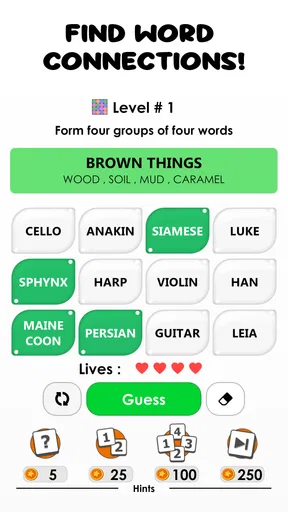
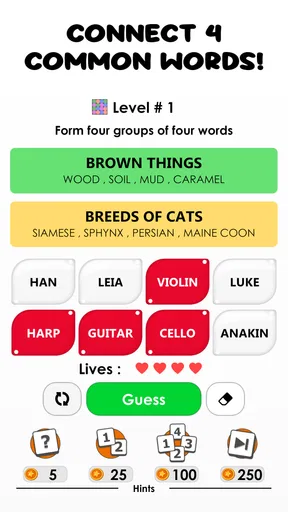
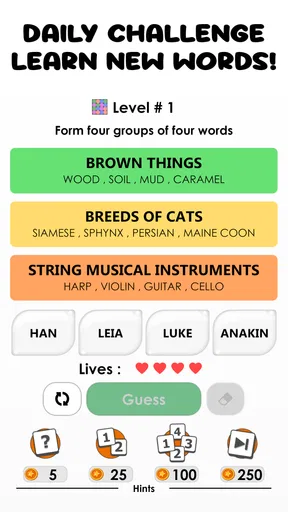
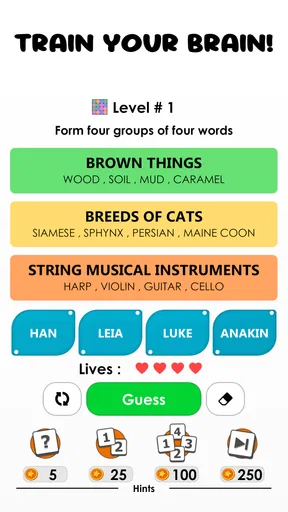
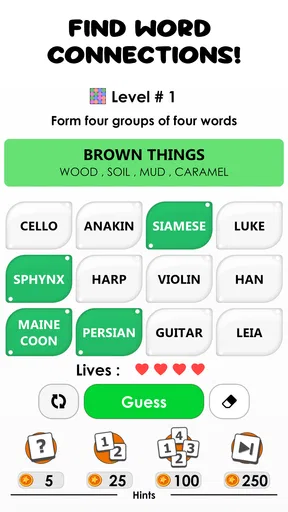
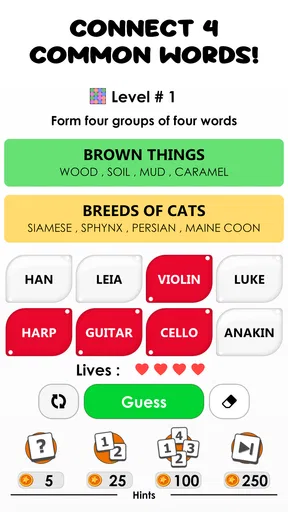
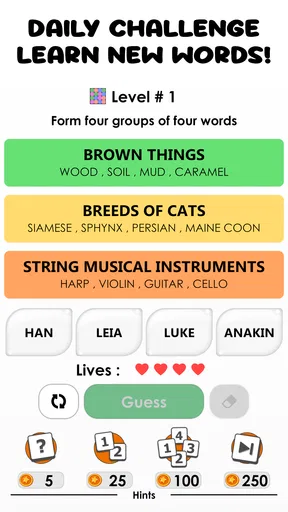
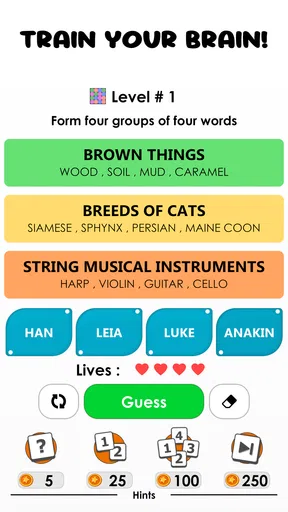
 Analysis by AppCompare
I spent time with Words: Associations Word Game as a compact word puzzle built around finding relationships rather than simply recalling definitions. The basic appeal is easy to understand: you look at a collection of words, search for meaningful connections, and arrange four related words into a group. That sounds simple, but the best rounds made me question my first assumption, which is exactly what I want from a casual word game. It is free to start, rated for Everyone, and developed by MEGARAMA, so it is approachable for a wide range of players.
What matters most here is not speed or dexterity. The challenge is mental flexibility. A word may fit several possible groups, while another may be deliberately tempting because it shares a broad association with the wrong answers. I found that the game rewards patience more than quick tapping, making it suitable for a short break, a quiet evening, or a shared puzzle discussion. Its average rating of 4.5 from around 2.3 thousand ratings suggests that many players enjoy this format, and the game has passed 100 thousand installs.
How the puzzle experience feels in everyday use
I find the everyday appeal of this puzzle lies in how it turns a quick glance at familiar words into a small exercise in changing perspective. I’ll look at how that plays out when I’m solving alone or talking through possibilities with someone else, then consider which kinds of breaks suit it best.
Readability and navigation that keep the focus on the words
The strongest part of the experience is the directness of the central task. I am not asked to learn a complicated control scheme before playing. The important information is the set of words in front of me, and the game’s concept is clear enough to understand almost immediately. That matters for anyone who prefers apps with a low learning curve, including people who may feel overwhelmed by menus, layered systems, or tutorial-heavy games.
In practice, I approach each board by scanning the whole group before selecting anything. That habit is more useful than immediately tapping the first connection I notice. A broad word can belong to multiple themes, and committing too early can make the rest of the board look more confusing than it really is. I recommend first identifying the most specific-looking relationship, then checking whether the remaining words form a cleaner group. This makes the game feel less like guessing and more like sorting evidence.
The format also supports a useful stop-and-return rhythm. If I reach a point where every word seems connected to everything else, stepping away for a few minutes can help. The puzzle does not require constant attention in the way an action game does, so it fits naturally into waiting rooms, commutes, or a coffee break. A player who dislikes time pressure will probably appreciate that the core activity is based on consideration rather than reflex.
There is a small trade-off in this simplicity. A word puzzle can be easy to enter but difficult to interpret. When a connection depends on a phrase, cultural reference, spelling pattern, or less familiar usage, the board may feel ambiguous instead of cleverly challenging. That is not necessarily a flaw, but it means the game will suit players who enjoy debating possible meanings more than those who want every answer to be immediately obvious.
Worth Reading Before You Choose

EA SPORTS FC Mobile 26 Is a Bigger Football Game, but It Takes Time

Flipboard Shows What News Apps Must Do Beyond the Feed

Switching to Android Auto Means Rethinking Your Driving Routine

Google Calendar Makes a Crowded Week Easier to Manage

Ludo King Makes the Most of the Minutes Between Plans

Baby Panda World Brings Quick Play to Modern Phones, but Its Game Library Feels Busy
Motor and sensory considerations
Because the game is built around selecting words, it places far less demand on motor speed than most mobile games. I do not need rapid swipes, precise timing, or repeated button presses to make progress. That makes it a reasonable choice for players who prefer slower interactions or find fast-paced touch controls tiring. The mental workload remains significant, but the physical workload is comparatively modest.
The main sensory requirement is visual reading. A player needs to distinguish the words, compare them, and keep several possible groupings in mind. Someone with reduced vision, reading fatigue, dyslexia, or sensitivity to dense screens may need to judge whether the presentation feels comfortable on their own device. I would not assume that a word-based format automatically works for every reader: the entire challenge depends on being able to inspect small pieces of text repeatedly and notice subtle differences between terms.
One practical approach is to play in a calm setting with the screen at a comfortable distance and brightness. I also found it helpful not to treat the board as something that must be solved in one intense burst. Reading each word aloud, either silently with deliberate attention or audibly when playing with someone else, can reveal associations that are easy to miss during rapid scanning. That turns a possible visual limitation into a more reflective process, although the game itself remains fundamentally text-led.
The absence of a speed requirement is especially valuable for mixed-ability play. One person can suggest a category while another handles the selections, or two players can discuss the possible groups before committing. This makes the game more socially flexible than a solo description might suggest. It can work as a quiet collaborative activity, provided everyone is comfortable with the reading demands and with the possibility that one player may recognize references faster than another.
Situational access: where the game fits best
I see this as a strong companion for short periods when I want something engaging but not absorbing enough to take over the entire day. A realistic example is a train journey with inconsistent attention: I can examine a board, pause when my stop approaches, and return to the same mental problem later. It also works well after work, when I want to exercise my attention without starting a long campaign or learning a complicated ruleset.
The game is less dependent on sound than many entertainment apps. The essential information is conveyed through written words and selections, so a noisy environment should not undermine the central puzzle in the same way it might affect a rhythm or voice-driven game. Conversely, it is not ideal for someone looking for a purely audio experience, because the words themselves are the content rather than an optional layer.
It can also become a useful family or friend activity. Instead of handing the phone around silently, players can explain why a word belongs in a group and challenge one another’s assumptions. That conversation highlights one of the game’s most interesting qualities: a wrong answer is often informative. It shows which association seemed strongest and why the board was misleading. For language learners, this kind of discussion may expose multiple meanings and common word combinations, although I would not treat it as a structured language course.
Compared with a conventional crossword, the game feels more compact and less dependent on writing answers into a grid. Compared with a word search, it asks for interpretation rather than visual hunting. Compared with a spelling game, it focuses less on producing a word and more on understanding how words relate. Those differences make it a better fit for players who enjoy categorization and lateral thinking, while someone who wants clues, a large grid, or vocabulary drills may prefer another format.
Specific strategies that make difficult boards fairer
My first useful strategy is to separate strong connections from merely possible ones. If three words clearly share a theme and the fourth is only vaguely related, I hold back rather than forcing the group. The fourth word may belong to a more precise category elsewhere. This simple distinction prevents the board from becoming a chain of impulsive guesses.
My second strategy is to look for the word with the fewest plausible homes. Some terms are broad and can support many interpretations; others are unusually specific. Starting with the specific word reduces the number of possible arrangements and often exposes the intended structure. I also compare the wording of a potential category in my head: a group should feel consistent, not just defensible after a long explanation.
A third useful habit is to use mistakes as information instead of treating them as a verdict on vocabulary. If a proposed group fails, I revisit the assumption behind it. Did I confuse a general association with a shared phrase? Did I overlook a second meaning? Did one word belong to the group only because it looked familiar? This approach is particularly helpful for players who become discouraged by ambiguous puzzles, because it turns an incorrect attempt into a method for narrowing the board.
For collaborative play, I recommend having each person name one possible group and explain the connection before anyone selects it. That keeps the discussion focused and avoids one confident player dominating the board through quick tapping. It also makes the game more inclusive for players who need extra reading time or who process associations differently. The puzzle becomes a conversation about language rather than a test of who reacts first.
Remaining barriers and practical trade-offs
The biggest barrier is the same feature that gives the game its identity: ambiguity. If you prefer puzzles with one obvious route, some boards may feel frustrating. A player can understand every individual word and still struggle because several relationships seem reasonable. That experience will be enjoyable for people who like nuance, but it may feel arbitrary to anyone seeking a clean, clue-led solution.
There is also a social barrier for players with different levels of cultural or linguistic familiarity. Associations are not equally obvious to everyone. A term that seems common to one person may be unfamiliar to another, and a group based on a particular usage can create an uneven experience. Playing with a friend can help, but it can also make the difference in background more visible. I would approach the game as a shared exploration of language rather than a measure of intelligence.
The free entry is helpful for trying the format, while optional in-app purchases range from around three dollars to around twenty-five dollars per item. I would make a deliberate choice about spending rather than buying impulsively after a difficult board. The game’s value comes from the thinking process, so purchases make the most sense only for someone who already enjoys the experience and understands what additional paid elements mean in their own play.
On the technical side, the current version is 3.2.1 and it supports devices running Android 6.0 or later. That gives it a relatively broad place in the Android ecosystem, though device comfort still depends on the individual screen and reading setup. The age rating of Everyone makes it suitable for general audiences, but that rating should not be confused with universal ease of use: reading ability, language familiarity, visual comfort, and tolerance for ambiguity still shape the experience considerably.
Who should try it, and who should choose something else
I would recommend this game to people who enjoy wordplay, category puzzles, and the satisfying moment when a messy board suddenly becomes organized. It is particularly good for players who want a thoughtful activity without a long story, complicated progression system, or physical challenge. It also suits households looking for a puzzle that can be discussed together rather than played competitively at high speed.
I would be more cautious about recommending it to someone who wants a predictable difficulty curve, explicit clues, or a game that can be enjoyed without reading. It is also not the best choice for players who become annoyed when a word has several plausible meanings. A crossword may be better for someone who likes clue-by-clue guidance, while a spelling game may be better for someone who wants direct vocabulary practice. Those alternatives are not necessarily more accessible in every way, but they place the mental demand in a different location.
For a new player, I suggest beginning without trying to solve the entire board immediately. Read all the words, mark the strongest pair or trio mentally, and ask what kind of connection would make the group precise. If the board feels crowded, describe the possible categories in ordinary language before selecting anything. This reduces the pressure to tap quickly and makes the central reasoning easier to follow.
An inclusive verdict after using it
Words: Associations Word Game is a focused, free word game from MEGARAMA that succeeds when you want language-based thinking in a small, approachable package. I like that it gives slower players room to reason and that it can shift naturally between solo play and conversation. Its design is most welcoming when the player has comfortable access to written text and enjoys interpreting relationships rather than following explicit instructions.
My recommendation comes with a clear qualification: this is not a universally effortless puzzle. Visual reading, language familiarity, and tolerance for uncertain connections all matter. Still, the low motor demand, lack of dependence on rapid reactions, and suitability for shared discussion give it useful advantages across different situations. The best way to play is patiently: treat each board as a set of hypotheses, not a race to the first answer.
With a 4.5 average and more than 500 reviews, it has already found an audience, and its free price makes experimentation easy. I would try it if you want a daily-style mental break centered on associations and categorization. I would skip it in favor of a clue-driven or more structured word game if ambiguity feels like friction rather than fun. For me, its appeal lies in that middle ground: simple to start, demanding enough to stay interesting, and flexible enough to support a quiet solo session or a thoughtful group discussion.
Pros
- Simple rules make it easy to start playing immediately.
- Short rounds fit well into quick breaks or commutes.
- Word associations help exercise memory and creative thinking.
- Clean interface keeps the focus on solving each puzzle.
- Works well for players who enjoy relaxed
- noncompetitive gameplay.
Cons
- Some puzzles may accept only one expected association.
- Difficulty can feel inconsistent between consecutive levels.
- Repeated word themes may reduce the challenge over time.
- Hints or extra attempts may be limited during difficult puzzles.
- Players seeking multiplayer features may find the experience too solitary.
FAQs for Words: Associations Word Game
What is Words: Associations Word Game?
Words: Associations Word Game is a vocabulary and word-association puzzle designed around finding connections between related terms. Instead of simply forming words from letters, you are asked to recognize themes, meanings, or conceptual links. The game is suitable for casual sessions, but some levels require careful thinking, a broad vocabulary, and the ability to look at familiar words from different perspectives.
How do you play Words: Associations Word Game?
Gameplay generally involves examining a group of words and identifying the correct association or category that connects them. You may need to select matching terms, solve a themed group, or determine the relationship between several clues. The challenge comes from avoiding misleading connections, since some words can fit more than one idea. Reading every option carefully is important before confirming an answer.
Is Words: Associations Word Game free to download and play?
Words: Associations Word Game can typically be downloaded for free, although the available version may include advertising, optional purchases, or additional content that requires payment. The core puzzles are usually accessible without spending money, but players should check the store listing for the current details. If you prefer uninterrupted play, an ad-removal or premium option may be available.
Can beginners play Words: Associations Word Game, or is it difficult?
The game is approachable for beginners because its basic concept is easy to understand, and early puzzles usually introduce the association mechanic gradually. However, later challenges can become noticeably more demanding, especially when clues have multiple possible meanings or rely on less common vocabulary. Players who enjoy word puzzles, trivia, and lateral thinking will likely find the difficulty satisfying rather than frustrating.
Does Words: Associations Word Game work offline?
Whether the game works fully offline can depend on the version installed and how its advertisements, progress synchronization, or extra puzzle packs are handled. Many standard levels may remain playable without a constant connection, but online access could still be required when launching the app, loading new content, or restoring purchases. It is best to test offline access after installation before relying on it during travel.


